
Transients on power grids
Energy devices & systems · Modeling, Simulation & AI · Example study
The events that stress a grid the most are over in microseconds.
Why transients matter
Grid studies usually start from steady-state behaviour. But lightning strokes, switching operations and faults unfold in microseconds, and their effect depends on how a surge travels through towers, lines and substations. Modeling transients shows where insulation is at risk and what protection has to withstand.
An example study
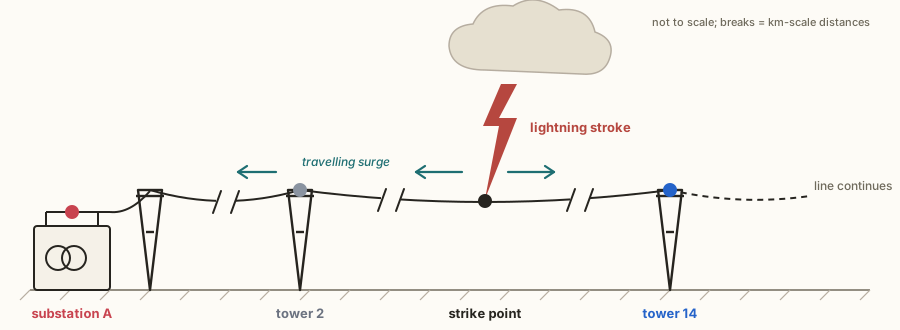
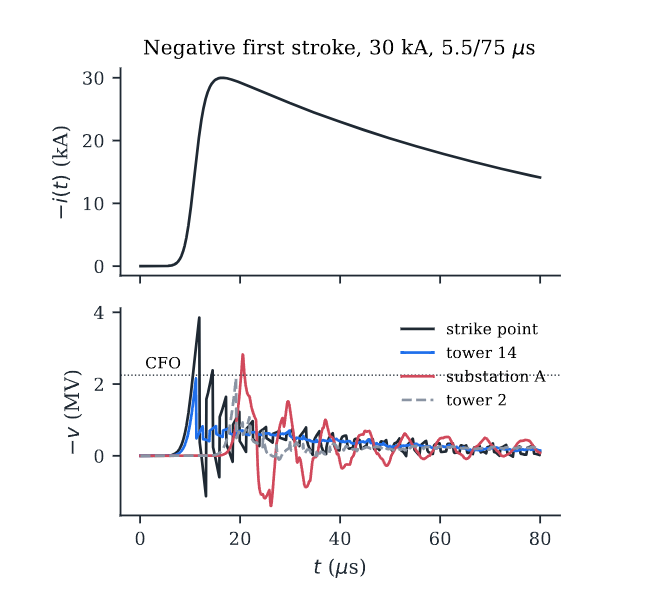
It is interesting to analyse the response of grid components and grid sections when facing transient phenomena. As an example of a possible study, I follow the response of a transmission line to a lightning strike at a fixed distance from other components, and how the signal is seen at the strike point, on two towers and at a substation.
The analysis may start from a single element and be pushed to more complex simulations, including reduced-order models (fast, simplified versions of a detailed simulation) and other data-driven methods.
At the system scale, my co-authored book The PyPSA Handbook (Bokde & Fanara, Elsevier) covers energy-system modeling — read more.
Have a grid or component question of this kind? info@dataphysics.ae